
Verified as of 29 November 2026.
Mod shops, not Pay 'n' Spray
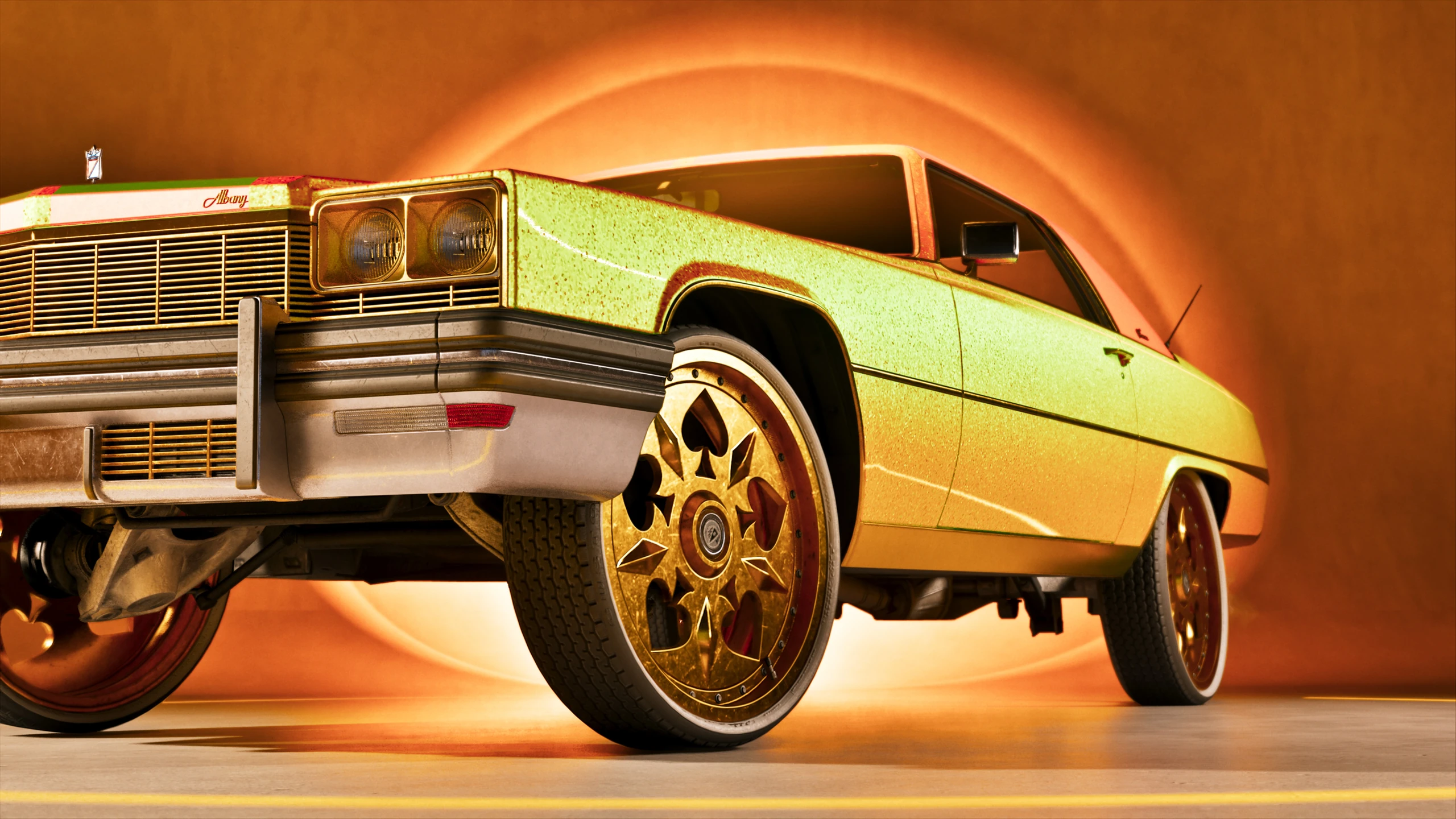
GTA 6 car customisation happens at mod shops, not at Pay 'n' Spray. There are 14 mod shops across Leonida, each specialising in one kind of vehicle, and every shop shows you what a part does to your car's five stats before you pay. But those numbers are menu previews, not lap times: no published source has measured what any upgrade actually saves on a timed run.
The honest verdict first
Exact performance effects of upgrades are undocumented. No source checked for this article publishes a timed before-and-after lap comparison for any single upgrade in GTA VI. The shop shows five stats — Speed, Acceleration, Asphalt Handling, Off-Road Handling and Strength. A stat going up by 0.3 is a menu figure, not a measured seconds-saved figure.
Where you customise
Your first visit is Coastal Auto Care in Key Lento, in the Chapter 1 mission Just a Scratch. Pay 'n' Spray is a different place: it repairs your car and changes its colour, and it sells no performance upgrades. Rideout Customs (donks) and One-Eyed Willie's Auto Shop (off-road) are Ultimate Edition only; the other twelve shops are open to all editions. The rest: Coastal Auto Care (retro) and Capri Classic (muscle) in Mariana; Two Wheel Fury Motorsport (sports bikes), Euroform Automotive (luxury), Vice Auto Customs (tuners), Lowballers Customs (lowriders), Vice Vinyl (wraps and liveries) and Stockyard Speedshop (hot rods) in Vice-Dale; Whisler Motorsport (racing), Dirt Merchants (dirt bikes) and Wasteland Off-Road (off-road) in Kelly; and Ledford Motorcycle Workshop (choppers) in Lummox.
Own the car first
You cannot modify a car you do not own. A stolen car must be registered first: tracker-free cars go to Moses in Port Gellhorn from Chapter 2, and standard-tracker cars at any Pay 'n' Spray from early Chapter 3. A damaged car cannot be modified until it is repaired. Expensive parts need a bank account, not pocket cash: Engine Upgrade Stage 2 and Nitrous Boost both require the BuckMe account from the Chapter 1 mission Buck Me. Do not sink money into Jason's Chapter 1 Ganado: the story replaces it later and every upgrade goes with it.
The six tabs
The shop menu has six tabs — Pro Builds, Cosmetics, Bodywork, Performance, Wheels and Interior — and highlighting any part previews its effect on the five stats before you buy it.
Performance: engine, intakes, transmission, boost
The Performance tab holds four groups: Full Engine, Intakes, Transmission and Boost. Engines go up to stage four, transmissions to level four. Full Engine: Stage 1 costs $900 on Jason's '70 Ganado — the one verified price in the game, logged by more than one source — and its menu preview reads +0.3 Speed and +0.3 Acceleration. Stage 2 is $1,800 on the Ganado, with gains that differ by car. Intakes: air filters and induction parts; prices seen run $700–$800, with no stat effect verified. Transmission: up to level four; Level 1 is $600 on the Ganado (single-source menu reading). Boost (nitrous): Nitrous Boost costs $5,000, needs a bank account, and gives a short burst of speed; on the Ganado its menu preview reads Speed 4.9 to 5.2 and Acceleration 5.5 to 5.9 — a preview, not a lap time.
No on-screen menu shows brakes or armour in GTA VI, and no source lists a turbo as a separate upgrade — do not buy expecting GTA V's tiers.
Suspension and Pro Builds
Suspension is not a standalone item in the Performance tab; it comes through kits. A Lowered Suspension Kit is sold as a Wheel Kit for $750 on the Ganado (single-source menu reading), and Wasteland Off-Road sells raised suspension kits and off-road tyres. The reported pattern is a trade-off: lowered gains road handling and loses off-road handling, raised does the reverse. Pro Builds are ready-made packages, sold as Full Kits and Wheel Kits and fitted in one go. On the Ganado, the Retro Build Standard is $1,535 and the Advanced is about $2,730–$3,030 (bank account required). On the Western '72 Cliffhanger, the Off-Road Build runs $2,055–$13,305 across three tiers.
Cosmetics: paint, liveries, wheels, interior
Most cosmetic customisation changes no stat at all. Cosmetics covers resprays, liveries, decals, plates and underglow. Bodywork covers hoods, spoilers, bumpers, towing, mirrors, windows, roofs and exhausts. Wheels covers rim styles and sizes, tyres and wheel kits; a Stock Calibration wheel kit is $250 (single-source menu reading). Interior covers seats, steering wheels, shifters, upholstery and trim. Vice Vinyl is the wraps-and-liveries specialist.
What it costs — the verified core
Only two prices were logged by more than one independent source on the same car: Engine Upgrade Stage 1 at $900 and Nitrous Boost at $5,000, both on Jason's '70 Ganado. Everything else here is a single-source menu reading, and prices are set per vehicle and vary between visits — the same bumper was seen at $390 and then $190. Read the price on your own car's screen before committing. Pro Build kits run from $1,535 to over $13,000; the site's garage planner records what you actually paid.
How to test an upgrade yourself
The shop's stat preview tells you what a part claims; a lap test tells you what it does. Pick a route and drive it stock, several times, under the same conditions, and keep the median time — one run proves nothing. Buy one upgrade only, then drive the same route the same way, several times, and take the median again. Enter both medians and what you spent in the site's upgrade-performance tool; it reports time saved, percentage improvement and cost per second saved. The full method is in the lap-test guide.
What would change this guide
A full price list per part, shop and vehicle — right now only two vehicles' menus have been read in any detail — and timed before-and-after measurements for each upgrade, agreed by two independent runs. Until then, this page stays what the evidence supports.
Related reading
- GTA VI guides
- Vehicle database
- Fastest car GTA 6: top speed tested and ranked
- Best cars GTA 6: top pick for every class
- Rarest cars GTA 6: where to find them
- GTA 6 planes and boats: air & sea guide
- Lap-test method guide
- Before/after comparison tool
- Garage planner for recording what you paid
- Vehicle upgrade calculator
Sources
- HeistAtlas — GTA 6 car customization: upgrades, nitrous, mod shops (six tabs; five stats; Engine Stage 1 $900 and Nitrous $5,000 logged by more than one source; 14 shops; Ganado replaced later in the story, upgrades lost with it)
- GTA6Gang — GTA 6 Car Customization: All 14 Mod Shops and How Tuning Works (updated 24 Nov 2026; Engine Stage 1 $900 +0.3/+0.3, Stage 2 $1,800, Nitrous $5,000)
- HowToVideoGame — GTA 6: How to Upgrade Car (launch-night play on own PS5 copy; Engine Stage 1 $900 +0.3/+0.3; Transmission Level 1 $600)
- KeenGamer — GTA 6: All 14 Mod Shop Locations and Vehicle Customization (24 Nov 2026; two Ultimate Edition shops)
- HotCars — GTA 6: All Vehicle Customization Options Explained (updated 23 Nov 2026; engine to stage four; transmission to level four)
- gamemapa — GTA 6 Car Upgrades: Mod Shops, Prices and Joey's Repair (20 Nov 2026; 14 mod shops, 19 Pay 'n' Sprays, 12 garages)
- GTAVibes — GTA 6 Car Customization: How to Mod Cars, Prices and All 14 Shops (Cliffhanger kits $2,055/$7,445/$13,305)
- VANOTHERLEVEL — GTA 6: Best Early Cars and How to Keep Them (read the mod-shop menus at full size in three launch streams)
- CutsceneWire — GTA 6 tuner mod shop location (specialist Pro Builds; curated wraps at Vice Vinyl)
- OutputLag — GTA 6 Mod Shops: All 14 Locations and What Each Does
- IGGM — GTA 6 Vehicle Mod Shops Explained (27 Nov 2026)
- NerdsChalk — Where to Customize Your Car in GTA 6 (Coastal Auto Care during Just a Scratch)
- Site ground truth — /guide-lap-tests/ (method guide: same route repeatedly, median of runs), /upgrade-performance/ (compares user-entered before/after runs), /garage/ (records registration and upgrade costs locally)
Verified as of 29 November 2026. Launch-week figures marked “reported” come from the sources above, not from GrindPilot’s own in-game verification.